Lesser-Known Vegan Dishes from North India and the Himalayas
North Indian food is widely assumed to mean butter chicken, paneer, and dal makhani. That is, North Indian restaurant food — the Mughal-influenced Punjabi-Delhi cuisine that has dominated international Indian menus for fifty years. The everyday North Indian kitchen, especially in the regions outside that Punjabi-Delhi belt, is something else entirely.
Roasted black gram dal in the Uttarakhand hills. Mustard greens cooked in mustard oil in Kashmir. Smoked eggplant bharta across the Punjab plains. Pearl millet drinks in the Rajasthan desert. Steamed rice dumplings in Bihar. North India's regional cuisines are far more plant-forward than restaurant menus suggest.
This is part four of a four-part field guide to lesser-known vegan dishes across India's regional cuisines. Part one covered South India. Part two covered East and Northeast India. Part three covered West India. This instalment closes the series.
Fifteen dishes across five regions: Uttarakhand and the Himalayas; Himachal Pradesh; Kashmir; Punjab; Rajasthan; and the Bihar–eastern Uttar Pradesh plains.
For the philosophical and historical backdrop on why so many Indian regional cuisines are naturally plant-based, see the earlier piece on veganism in India's cultural and historical roots.
Uttarakhand and the Himalayas
The Garhwal and Kumaon regions of Uttarakhand cook with what grows at altitude — drought-tolerant lentils, foraged greens, finger millets, pearl millet, and apricot kernel oil. Dairy plays a smaller role here than in the plains. The mountain kitchen has its own quiet logic, evolved over centuries to feed people in cold winters at high elevation.
1. Chainsoo
A traditional dish made from whole black gram lentils (urad dal) that are first dry-roasted, then ground into a coarse powder, and finally cooked in spiced water with ginger, garlic, cumin, and dried red chillies. The roasting step is what defines the dish — it produces a deep, nutty flavour that no standard dal preparation comes close to.
The texture is thicker than a soup but looser than a paste. Traditionally cooked in an iron kadai, which adds dietary iron through contact with the cooking surface. Eaten with rice or millet roti. High in protein, slow-digesting, and warming — characteristics suited to the high-altitude diet it evolved from.

2. Kafuli
A green curry made from a base of spinach and fresh fenugreek leaves, simmered with rice flour as a thickener. The greens are first wilted, then puréed, then returned to the pan with spices — turmeric, dry red chilli, fennel, and sometimes hing (asafoetida).
The rice flour thickening method is distinct from the dairy-based finishing common in northern Indian green curries. Kafuli sets to a porridge-like consistency without any cream or yoghurt. Eaten with steamed rice and a side of pickled radish. Naturally vegan, deeply traditional, and almost entirely unknown outside the Garhwal region.
3. Bhatt ki Churkani
A black soybean (bhatt) curry is traditional to the Uttarakhand hills. The black soybeans are soaked overnight, then cooked with chopped onion, garlic, ginger, turmeric, and a tempering of cumin and dried red chillies in mustard oil. The dish thickens naturally as the beans break down during cooking.
Bhatt is grown only at altitude — a regional variety specific to the Uttarakhand hills that does not grow elsewhere in India. The dish is iron-rich, protein-dense, and slow-cooked. Often served with bhat khichdi (a rice-and-black-soybean dish) or simple steamed rice.
4. Siddu (Himachal Pradesh)
A Himachali steamed dumpling. A wheat flour dough is leavened with yeast and rested for several hours. Each dough ball is then stuffed with a filling — traditionally poppy seed paste with spices, or walnut and dried fruit, or sometimes pulses — and steamed until cooked through.
The result is a soft, slightly chewy stuffed bread that is unlike any other Indian dumpling. Served with dal, chutney, or simply ghee in non-vegan versions. The vegan version uses mustard oil or melted vegan butter as the finishing fat. It is hyper-local to Himachal Pradesh and is rarely found outside the state.

Kashmir
Kashmiri cuisine is famous internationally for its meat-heavy wazwan banquet. The everyday Pandit and Muslim home kitchens tell a different story. Many home dishes are vegan by default, especially during religious fasting periods. The food relies on mustard oil, dry spices (Kashmiri red chilli, saunf, ginger powder), and indigenous vegetables — particularly lotus stem (nadru), turnip, and the dark green Kashmiri haakh.
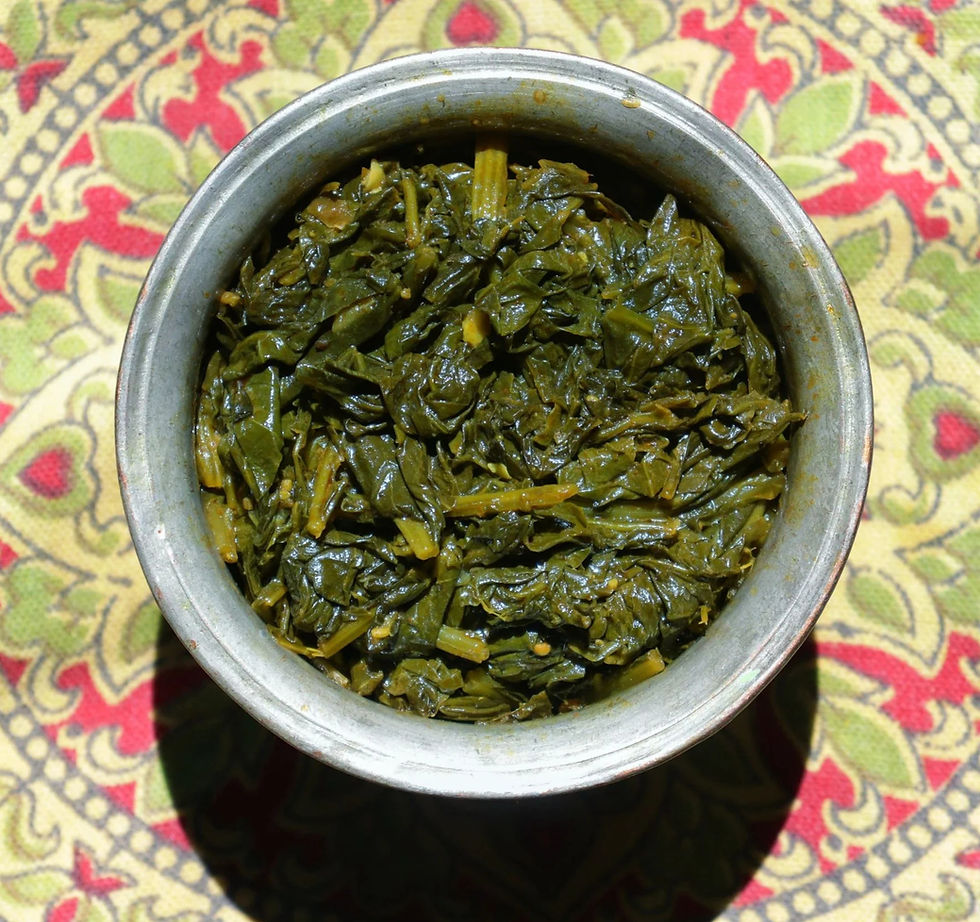
5. Haakh
The everyday green of Kashmiri kitchens. Collard greens (sometimes mustard greens or a variant of kale) cooked in mustard oil with whole dry red chillies, hing, and a small amount of water. No onion, no garlic, no tomato, no dairy.
The technique matters: the leaves go into hot mustard oil that has been briefly smoked to mellow its sharpness, then the dish is finished with water and a closed lid for two minutes. The greens retain their structure rather than collapsing. Served with rice and a side of pickled radish.
Eaten almost daily across the Kashmir valley. One of the few traditional Kashmiri dishes that is fully vegan without any modification.
6. Modur Pulao
A sweet rice preparation served at Kashmiri weddings and festive occasions. Basmati rice is cooked with sugar, ghee (or oil in vegan versions), saffron, cardamom, cinnamon, and dry fruits — typically almonds, raisins, and walnuts. Cooked until the rice is tender and the sugar caramelises slightly at the bottom.
The flavour profile is unlike any other Indian rice preparation. Modur pulao is not a dessert in the strict sense — it is served alongside savoury dishes during festive meals. Naturally vegan when prepared with neutral oil instead of ghee. The dry fruits do most of the flavour work.
7. Rajma Gogji
A Kashmiri preparation that combines kidney beans with turnip (gogji). The kidney beans are cooked separately and then added to a turnip-based gravy spiced with ginger powder, asafoetida, and Kashmiri red chilli. Mustard oil is the cooking fat.
The dish has a distinctive earthy sweetness from the turnips that pairs with the savouriness of the kidney beans. Naturally vegan and one of the more substantial plant-based dishes in the Kashmiri repertoire.
Punjab
The everyday Punjabi kitchen, particularly in rural areas, is far less dairy-dependent than restaurant Punjabi food suggests. Mustard oil is the everyday cooking fat. Whole grain flatbreads — bajra, makki (corn), jowar — are standard. Many traditional dishes are naturally vegan or trivially adaptable.
Mustard greens cooked slowly with spinach, bathua (chenopodium), ginger, garlic, and green chilli. The greens are simmered for an hour or more, then mashed with a wooden churner until smooth. Traditionally finished with a generous spoonful of butter or ghee on top; the vegan version uses mustard oil or melted vegan butter.
The flavour comes from the slow cooking and the mix of three greens, not from the fat. The dish is the iconic winter meal of rural Punjab, eaten with makki di roti (corn flatbread) and chopped onion. The vegan version is structurally complete without the dairy finish — the fat is a topping, not a base.
9. Bharta
Smoked eggplant. A whole eggplant is roasted directly over a flame (gas burner, charcoal, or wood fire) until the skin blackens entirely and the inside collapses. The charred skin comes off, and the soft smoky interior is mashed with chopped onion, tomato, ginger, garlic, green chilli, fresh coriander, and a tempering of cumin in mustard oil.
The smoke is what defines bharta. No amount of liquid smoke or oven roasting matches the flavour of a properly fire-roasted eggplant. Served with chapati or with rice and dal. Naturally vegan in its traditional Punjabi rural form, though urban restaurant versions sometimes add cream.
10. Aloo Wadiyaan
A potato curry made with sun-dried lentil cakes (wadiyaan). The wadiyaan are crumbled into hot mustard oil and fried until golden, then onion, tomato, ginger, garlic, and spices are added. Cubed potatoes go in next, with water for a thin gravy. The whole thing simmers until the potatoes are tender and the wadiyaan have softened.
Wadiyaan are made by soaking and grinding urad dal, then forming the paste into small mounds and sun-drying them for days. The drying concentrates flavour and changes texture entirely. Aloo wadiyaan is a winter Punjabi staple — substantial, deeply spiced, and naturally vegan.
Rajasthan
Rajasthan's historically arid climate — limited water, limited fodder — produced a cuisine built around dried legumes, preserved ingredients, and drought-tolerant crops rather than fresh produce or extensive dairy. The result is one of the most resourceful plant-based cuisines on the subcontinent.
11. Bajra Raab
A traditional Rajasthani drink-meal hybrid. Pearl millet flour (bajra) is mixed with cold water to a thin paste, then cooked over low heat with ginger, ajwain (carom seeds), and salt until it thickens to a porridge consistency. Served warm in winter as both food and drink.
The flavour is mild, slightly nutty, and warming. Bajra is among the most drought-resistant grains in India, and it became the staple of the Rajasthan desert because it grew where rice and wheat could not. Raab is the simplest possible preparation — flour and water — and it has fed the region for centuries.
12. Pyaaz Kachori
A deep-fried pastry stuffed with a spiced onion filling. The dough is made from refined flour, semolina, and oil (no dairy). The filling combines finely chopped onion, gram flour (besan), and a precise blend of fennel, coriander, cumin, and dried chilli, cooked briefly until aromatic. Small dough balls are stuffed and sealed, gently flattened, then deep-fried until golden and crisp.
Pyaaz kachori is the standard breakfast in Jodhpur. Served with tamarind chutney and a glass of hot masala chai. Naturally vegan in its traditional form.

13. Pitod ki Sabzi
A Rajasthani preparation that solves a desert problem — how to make a substantial curry when fresh vegetables are scarce. A thick gram flour batter is cooked in oil with turmeric and salt, then poured into a flat tray, allowed to set firm, and cut into cubes. The cubes are then cooked in a yogurt-spice gravy (replaced with cashew cream or coconut yogurt in the vegan version) with mustard seed, cumin, and dried red chillies.
The dish is a sensible response to ingredient scarcity — gram flour is shelf-stable, the cubes provide protein and substance, and the gravy carries the flavour. Naturally vegan when the dairy gravy is replaced with a plant-based version.
Bihar and Eastern Uttar Pradesh
The plains cuisine of Bihar and eastern UP relies on roasted gram flour (sattu), whole grains, and simple one-pot cooking. The food is straightforward, energy-dense, and historically the food of farmers and travellers.
14. Pittha
Steamed rice flour dumplings, served either savoury or sweet. The savoury version stuffs the rice flour dough with a mixture of chana dal cooked with spices (cumin, ginger, green chilli). The sweet version stuffs it with grated coconut and jaggery. The stuffed dumplings are then steamed in banana leaves or in a steamer for 15–20 minutes.
Pittha is the traditional festival food of Bihar and eastern UP. The savoury version is eaten as a main meal with a side of mustard-oil pickle; the sweet version is served as dessert during religious festivals like Chhath Puja. Naturally vegan in both forms.
15. Tehri
A UP-style rice and vegetable one-pot. Basmati rice is cooked with potato, cauliflower, peas, carrot, and a tempering of cumin, bay leaf, and whole spices in mustard oil. The vegetables and rice cook together — flavours meld in a single pot.
Tehri is the everyday rice dish of UP households when biryani feels too rich or too complex. Naturally vegan, complete as a meal with a small bowl of pickle or chutney, and quick — usually under 30 minutes from start to plate. One of the most accessible dishes in the entire series.
What These Dishes Have in Common
Three patterns hold across the northern regions:
Mustard oil is the universal cooking fat outside the Mughal-influenced belt. From the Himalayan hills through Kashmir, Punjab, and into Bihar, mustard oil is what coconut oil is to the South and what groundnut oil is to Gujarat. Sharp, pungent, and structural to the cuisine.
Grains other than wheat carry the regional identity. Bajra (pearl millet), jowar (sorghum), makki (corn), ragi (finger millet), and barnyard millet appear across all the northern regions in ways that wheat does not. Restaurant North Indian food has reduced this diversity to one grain. Home cooking has not.
Foraged and seasonal greens dominate where industrial vegetables don't reach. Haakh in Kashmir, fenugreek and spinach in Garhwal, mustard greens in Punjab, bathua across the northern plains. These cuisines pull from a much wider plant vocabulary than mainstream Indian cooking does.
Frequently Asked Questions
What are some lesser-known vegan dishes from North India?
North India's lesser-known vegan dishes span Himalayan grain cookery (chainsoo, kafuli, bhatt ki churkani from Uttarakhand), Kashmiri Pandit cooking (haakh, modur pulao, rajma gogji), Punjabi everyday cooking (sarson da saag, bharta, aloo wadiyaan), Rajasthani drought cuisine (bajra raab, pyaaz kachori, pitod ki sabzi), and Bihari one-pots (pittha, tehri). Most use mustard oil, grains, and local greens rather than dairy.
Isn't North Indian food mostly dairy-based?
In North Indian cuisine, dairy plays a prominent role — paneer, cream, butter, ghee. Everyday home cooking is much more varied. Himalayan, Kashmiri Pandit, and Rajasthani home cuisines use far less dairy than the Mughal-influenced Punjabi-Delhi food that dominates restaurants. Many traditional dishes are naturally vegan or one swap away from it.
What is chainsoo?
Chainsoo is a traditional Uttarakhand dish made by dry-roasting whole black gram lentils (urad dal), grinding them into a coarse powder, then cooking the powder in spiced water with ginger, garlic, and chillies. The roasting step is what defines the dish — it produces a deep, nutty flavour unlike that of any standard dal. Traditionally cooked in an iron kadai.
Is Kashmiri food vegan-friendly?
Kashmiri Pandit and Muslim home cooking includes a substantial vegan thread, especially during fasting periods. Haakh (mustard greens in mustard oil), nadru (lotus stem) preparations, modur pulao (sweet rice with dry fruits), and rajma gogji (kidney bean with turnip) are all traditionally vegan. The famous Kashmiri wazwan banquet is meat-heavy, but everyday Kashmiri home cooking is much more plant-forward.
What is bajra raab?
Bajra raab is a Rajasthani drink made from pearl millet flour, water, and seasoning. The flour is cooked in water until it forms a thin porridge, then seasoned with ginger, ajwain (carom seeds), and salt. Traditionally served warm during cold desert mornings as both food and drink. Naturally vegan, deeply warming, and one of the most distinctive plant-based preparations of the desert region.
Where can I learn to cook traditional North Indian vegan dishes?
The most direct path is travel — eat these dishes in the regions where they're made, especially Kashmir Pandit households, Himalayan villages, and Rajasthani rural kitchens. Many dishes are rarely cooked outside their home regions. For home cooking, regional recipe blogs and YouTube channels from each state are the best resource.
Closing the Series
Four parts, four regions, sixty lesser-known vegan dishes. From the dosa and idli of South India to the fermented soybean of the Northeast to the chickpea-flour preparations of the West to the mountain millets of the North, the series has covered the breadth of plant-based regional Indian cooking that almost never appears on restaurant menus or in international food coverage.
What ties them together is not a shared set of ingredients or a shared technique. It is the underlying logic of regional cuisines that evolved before industrial food production and before dairy consolidation — cuisines that figured out how to feed people well with what was locally available, which in most of India was overwhelmingly plant-based.
The dishes in this series are proof that plant-based cooking is not a recent dietary movement but a foundational part of Indian food culture. They have been cooked for generations in millions of homes, by people who weren't thinking about diet labels at all.
Recreating these dishes at home — from any region — comes down to the same set of foundational techniques. Tempering, roasting, fermentation, mustard oil handling, coconut work, and sourcing indigenous ingredients. At The Vegan School, those underlying techniques are taught at their residential programme. The regional dishes themselves are best learned at the source — in the kitchens where they evolved.
This is the closing of the four-part series. The next blog post will move to a different topic.


Comments